
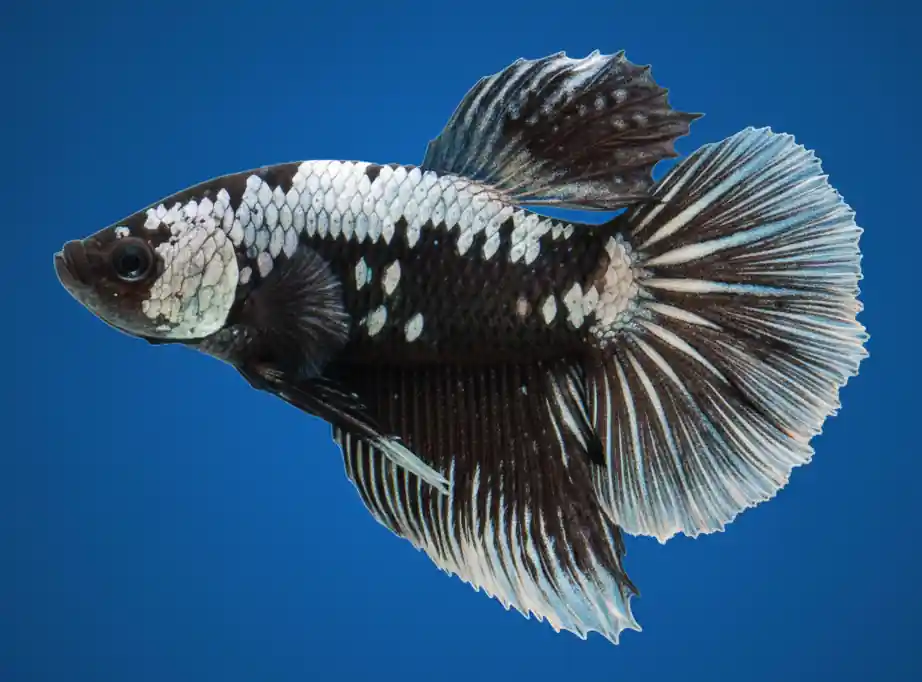
Samurai Plakat Male Betta
Samurai Plakat Male Betta(Betta splendens) carries the Dragon Scale gene — thick, overlapping metallic scales with an armored, reptilian appearance. The Samurai name reflects the warrior aesthetic of the dense metallic scaling on a powerful Plakat body. The Plakat is the short-tailed form ofBetta splendens— the tail type closest to the wild betta, with compact, rounded fins that are considerably shorter than the flowing forms of Halfmoon or Veiltail bettas. The Plakat’s shorter fins mean less drag and more agility — Plakat bettas are noticeably faster, more active, and more powerful swimmers than their long-finned relatives. The compact fins are also more durable and less susceptible to damage. Many experienced betta keepers consider the Plakat the most naturally expressive and behaviorally engaging tail form.
Betta splendens— the Siamese Fighting Fish — is native to the rice paddies, floodplain pools, and slow-moving streams of Thailand, Cambodia, Laos, Vietnam, and surrounding Southeast Asia. Bettas are among the most cognitively aware freshwater fish in the hobby. They recognize individual humans — distinguishing their keeper from strangers by face and silhouette — and learn the meaning of familiar movements like approaching the tank or picking up the food container. Each fish has a genuinely distinct personality: some are bold and immediately investigative, others cautious and deliberate, others theatrical displayers that perform at every opportunity. A betta in a properly enriched aquarium with plants, sight lines, and visual stimulation outside the glass is an actively engaged animal that rewards attentive observation. We recommend giving your betta a name — keepers who do consistently report a stronger bond and more attentive care, and their fish tend to show for it.
Select Your Exact Fish — WYSIWYG:This listing is part of ourWhat You See Is What You Getcollection. Each betta is individually filmed in their container and video previews are available oncuboidstore.com. Browse the videos, find the fish you want, note thecontainer number in the bottom right corner of the video, place your order, and include that number in your order notes. You will receive exactly that fish — not one like it.
People in Thailand have kept and selectively bredBetta splendensforat least 1,000 years— one of the longest domestication histories of any fish. The breeding tradition focused increasingly on color and fin development over the centuries, producing fish of growing beauty long before they reached the rest of the world. In 1840, King Rama III gave specimens to Danish physician Theodore Cantor, who published the first Western scientific description. Bettas arrived in France in 1892, Germany in 1896, and reached San Francisco in 1910 via importer Frank Locke. It was not until 1927 that the first brightly colored, long-finned specimens reached the United States — transforming the fish from a foreign curiosity into the spectacular ornamental varieties the world knows today. The scientific nameBetta splendens, given by Charles Tate Regan of the British Museum in 1909, means “gleaming fighter” — combiningsplendens(brilliant, shining) with a reference to the ancient Bettah people of Southeast Asia.
The Cuboid Betta Wall:Our bettas are housed in our260-container Betta Wall— one of the largest dedicated betta displays you will find anywhere. Every container has its ownheated, filtered, UV-sterilized waterand a live plant, giving each fish its own stable, enriched environment. While the containers are sized for retail housing rather than permanent home setups, the water quality and conditions are maintained at a standard well above typical retail. When you receive a betta from Cuboid, it has been kept properly — not in a cup.
The ideal home aquarium for a betta is a minimum of5 gallons— 10 gallons gives more stable water temperature, better water quality, and more territory to explore and inhabit.A heater is required.Bettas are tropical fish that need78–82°F (25–28°C)consistently. Room temperature in most US homes falls below this range, particularly in winter, and bettas kept too cool are noticeably less active, less colorful, and significantly more prone to disease. Bettas also possess a specialized breathing organ called thelabyrinth organ— a structure above the gills that allows them to extract oxygen directly from atmospheric air at the surface. Unobstructedsurface access is a biological necessity. Never cover the surface so completely that a betta cannot reach open air.
⚠ Filter Flow:Bettas are native to slow-moving rice paddies and still forest pools — strong current stresses them, exhausts their fins, and can prevent them from swimming comfortably. Use agentle sponge filteror baffle a hang-on-back filter to reduce outflow. The surface should ripple gently — not churn.
Plants are genuine habitat for bettas, not merely decoration. Floating plants provide shade and surface cover that significantly reduces stress.Indian almond leaves(Catappa) are particularly valuable — they release tannins that replicate the natural blackwater chemistry of betta habitat and have mild antibacterial and antifungal properties. Add one or two leaves per 5 gallons and replace monthly. The slight amber tint they produce is entirely natural and beneficial.
Feeding & Care Tip:Hikari Betta Goldis our recommended staple food. Feedone pellet at a time— if your betta eats it, offer another, up tothree pellets twice daily. If they do not eat a pellet, do not add another — remove uneaten food promptly to protect water quality. Fasting one day per week supports digestive health.
For treats, rotateHikari Frozen Bloodworms,Hikari Frozen Baby Brine Shrimp, andHikari Frozen Daphnia2–3 times per week. Daphnia acts as a gentle digestive aid — worth including weekly as bettas on an all-pellet diet can be prone to bloating.
When setting up your betta’s new aquarium, addSeachem Betta Basicsto the water — a betta-specific conditioner that neutralizes chlorine and chloramines and provides a slime coat supplement. It does not contain aloe vera, which can coat the water surface and interfere with a betta’s surface breathing. Use it at every water change going forward.
Male bettas cannot be housed together — one male per tank, always. With peaceful, non-fin-nipping community fish in a larger aquarium they can coexist well: small Corydoras, Ember Tetras, small rasboras, and snails are typically compatible. Avoid confirmed fin-nippers such as Tiger Barbs and Serpae Tetras, and brightly colored fish with flowing fins that a betta may perceive as a rival.
Most fish are kept. Bettas are known. Give one the right environment, learn its habits, and you will find yourself checking on it not out of obligation but out of genuine curiosity about what it is doing. That is the experience that has madeBetta splendensone of the most kept fish on Earth for over a thousand years — and it starts with the fish you choose.
| Samurai Plakat Male Betta | |
|---|---|
| Difficulty | Beginner — Easy |
| Temperament | Males must be kept one per tank |
| Adult Size | 2.5–3.0 inches (6–7.5 cm) |
| Group Size | One male only — no other male bettas |
| Ideal Temperature | 78–82°F (25–28°C) — heater required |
| Ideal pH | 6.5–7.5 |
| Ideal GH | 3–12 dGH |
| Ideal KH | 2–8 dKH |
| Staple Food | Hikari Betta Gold — one pellet at a time, up to 3 pellets twice daily; remove uneaten food promptly |
| Treat / Supplement | Hikari Frozen Bloodworms; Hikari Frozen Baby Brine Shrimp; Hikari Frozen Daphnia (weekly for digestive health) |
| Origin | Thailand, Cambodia, Laos, Vietnam, and surrounding Southeast Asia |
| Notes | Filtration:Gentle sponge filter or baffled HOB only — no strong current Surface Access:Required at all times — labyrinth organ breathes atmospheric air Minimum Tank:5 gallons — 10 gallons recommended New Tank:Seachem Betta Basics at setup and every water change (no aloe vera — safe for surface breathing) Enrichment:Indian almond leaves; floating plants; live plant in tank |
Reviews
There are no reviews yet.