
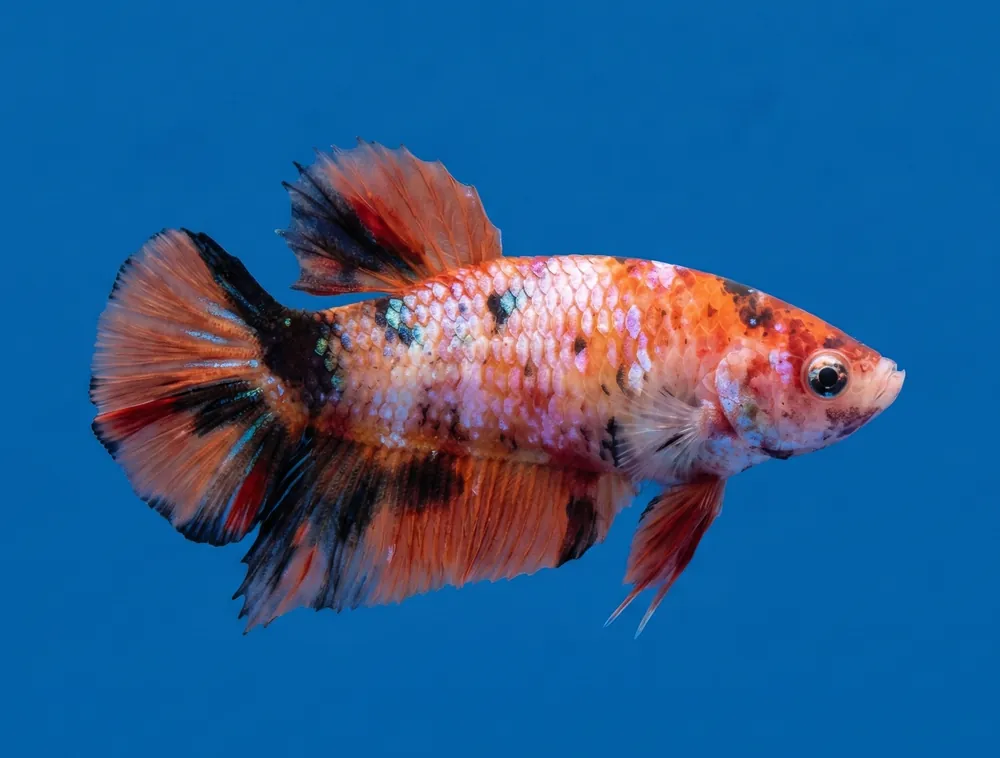
Galaxy Halfmoon Female Betta
Galaxy Halfmoon Female Betta(Betta splendens) displays the Galaxy pattern — iridescent speckles scattered across the fins like stars — combined with the Halfmoon tail form. The scattered iridescent fin points are visible across the broad Halfmoon tail spread.
Betta splendens— the Siamese Fighting Fish — is native to the rice paddies, floodplain pools, and slow-moving streams of Thailand, Cambodia, Laos, Vietnam, and surrounding Southeast Asia. Bettas are among the most cognitively aware freshwater fish in the hobby. They recognize individual humans, learn feeding schedules, and develop distinct personalities over time. Female bettas are often more active and exploratory than males — equally personable and equally rewarding as individual pets. We recommend giving your betta a name — keepers who do consistently report a stronger bond and more attentive care, and their fish tend to show for it.
People in Thailand have kept and selectively bredBetta splendensforat least 1,000 years— one of the longest domestication histories of any fish. The breeding tradition focused increasingly on color and fin development over the centuries, producing fish of growing beauty long before they reached the rest of the world. In 1840, King Rama III gave specimens to Danish physician Theodore Cantor, who published the first Western scientific description. Bettas arrived in France in 1892, Germany in 1896, and reached San Francisco in 1910 via importer Frank Locke. It was not until 1927 that the first brightly colored, long-finned specimens reached the United States — transforming the fish from a foreign curiosity into the spectacular ornamental varieties the world knows today.
The ideal home aquarium for a betta is a minimum of5 gallons— 10 gallons gives more stable water temperature, better water quality, and more territory to explore.A heater is required.Bettas need78–82°F (25–28°C)consistently. Bettas also possess a specialized breathing organ called thelabyrinth organthat allows them to extract oxygen directly from atmospheric air at the surface. Unobstructedsurface access is a biological necessity— never cover the surface completely.
⚠ Filter Flow:Bettas are native to slow-moving rice paddies and still forest pools — strong current stresses them and exhausts their fins. Use agentle sponge filteror baffle a hang-on-back filter to reduce outflow. The surface should ripple gently — not churn.
Plants are genuine habitat for bettas, not merely decoration. Floating plants provide shade and surface cover that significantly reduces stress.Indian almond leaves(Catappa) release tannins that replicate the natural blackwater chemistry of betta habitat and have mild antibacterial and antifungal properties. Add one or two leaves per 5 gallons and replace monthly.
Sorority Tanks:Female bettas can coexist in groups called sororities and, with the right setup, can thrive together beautifully. Success depends on getting the conditions right from the start: aminimum of 20 gallons,groups of 5 or more(smaller groups concentrate aggression on fewer individuals), aheavily planted aquariumwith multiple sight-line breaks so no single fish can see or dominate the entire space, and all femalesintroduced simultaneouslyrather than one at a time. The first two weeks are the critical period — monitor daily and be prepared to remove any fish that is being persistently singled out. With appropriate space and structure, a well-established sorority is one of the most dynamic and rewarding freshwater aquarium setups available.
Female bettas also make excellent individual pets — equally personable, often more active and exploratory than males, and with the same strong keeper recognition and individual personality.
Female bettas kept in peak condition will often show visible vertical barring on the body — a sign of readiness to spawn. Betta breeding is a rewarding intermediate project: condition both fish on live or frozen foods for one to two weeks before introduction, and introduce the pair visually first through a divider before allowing full contact. The male will build abubble nestat the surface — a cluster of mucus-coated bubbles where the eggs are placed and guarded after spawning. Once spawning is complete the female should be removed, as the male’s paternal aggression will turn toward her. Fry require infusoria or micro-fry food for the first few days before graduating to baby brine shrimp, and young males must be separated at around 8–10 weeks as aggression between them develops. If you are interested in breeding your female betta, we are happy to provide guidance.
Feeding & Care Tip:Hikari Betta Goldis our recommended staple food. Feedone pellet at a time— if your betta eats it, offer another, up tothree pellets twice daily. Remove uneaten food promptly. Fast one day per week for digestive health.
For treats, rotateHikari Frozen Bloodworms,Hikari Frozen Baby Brine Shrimp, andHikari Frozen Daphnia2–3 times per week.
When setting up your betta’s new aquarium, addSeachem Betta Basics— a betta-specific conditioner that neutralizes chlorine and chloramines and provides a slime coat supplement. It does not contain aloe vera, which can coat the water surface and interfere with surface breathing. Use it at every water change.
Most fish are kept. Bettas are known. Give one the right environment, learn its habits, and you will find yourself checking on it not out of obligation but out of genuine curiosity about what it is doing. That is the experience that has madeBetta splendensone of the most kept fish on Earth for over a thousand years — and it starts with the fish you choose.
| Galaxy Halfmoon Female Betta | |
|---|---|
| Difficulty | Beginner — Easy |
| Temperament | Females can be kept singly or in sorority groups of 5+ (20 gallon minimum) |
| Adult Size | 2.0–2.5 inches (5–6.5 cm) |
| Group Size | Singly, or sorority of 5 or more — never 2–4 |
| Ideal Temperature | 78–82°F (25–28°C) — heater required |
| Ideal pH | 6.5–7.5 |
| Ideal GH | 3–12 dGH |
| Ideal KH | 2–8 dKH |
| Staple Food | Hikari Betta Gold — one pellet at a time, up to 3 pellets twice daily |
| Treat / Supplement | Hikari Frozen Bloodworms; Hikari Frozen Baby Brine Shrimp; Hikari Frozen Daphnia (weekly for digestive health) |
| Origin | Thailand, Cambodia, Laos, Vietnam, and surrounding Southeast Asia |
| Notes | Filtration:Gentle sponge filter or baffled HOB only — no strong current Surface Access:Required at all times — labyrinth organ breathes atmospheric air Minimum Tank:5 gallons single; 20 gallons minimum for sorority New Tank:Seachem Betta Basics at setup and every water change Enrichment:Indian almond leaves; floating plants; live plant in tank Breeding:Condition on live/frozen foods; introduce visually first; remove female after spawning; fry need micro-fry food initially |
Reviews
There are no reviews yet.