
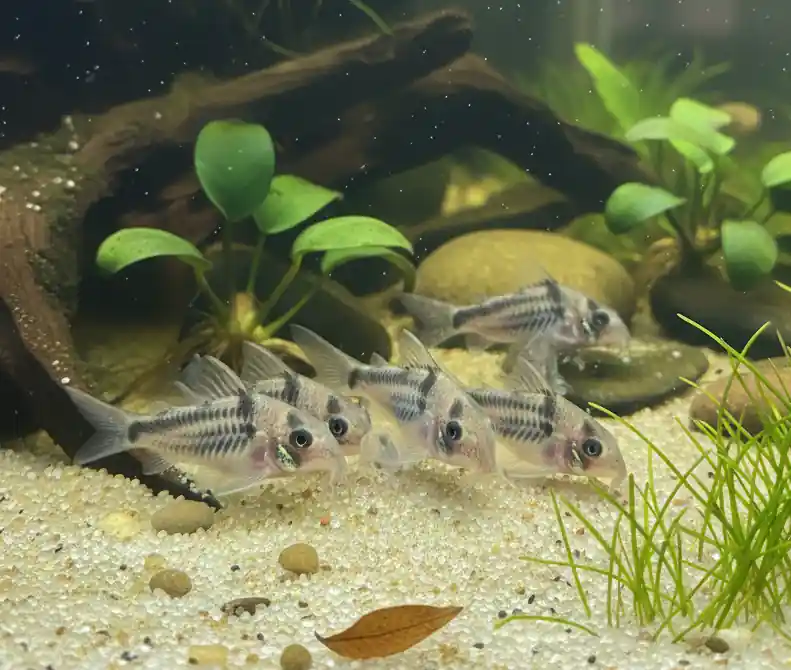
Corydoras loxozonus
Corydoras loxozonus(Corydoras loxozonus) is an elegant and less commonly available species from Colombia with a distinctive oblique dark band running diagonally across the rear of the body — the nameloxozonusmeans ‘oblique band.’ The pale body with this angled dark marking gives the fish a distinctive, graphic appearance.
Feeding & Care Tip:Hikari Sinking Wafersmake an excellent daily staple andSera Vipachips Tropical Wafersare an excellent alternative. Supplement 2–3× per week withHikari Frozen or Freeze-Dried Tubifex Worms, Hikari Frozen or Freeze-Dried Baby Brine Shrimp. Feed near the substrate at or after lights-out when corydoras are most active.
Native to Colombia (Orinoco drainage). In the aquarium, soft to medium, slightly acidic to neutral water with fine sand substrate, gentle filtration, and shaded areas created by driftwood or plants replicates the natural habitat and produces the most active, healthy behavior.
Keep in groups of at least six — this is not optional for Corydoras. In the wild these fish occur in schools of dozens to hundreds. A lone Corydoras or a group of fewer than six is a stressed fish that stays hidden, refuses food, and lives a shortened life. In a proper group they are bold, constantly active, and endlessly entertaining to watch as they forage together across the bottom of the aquarium.
Corydoras are highly sensitive to substrate quality — fine sand is strongly preferred over gravel, as rough substrates damage the delicate barbels they use to forage. Regular partial water changes and pristine water quality are essential, as all Corydoras are sensitive to nitrites and dissolved waste. Sand substrate, gentle flow, and shaded areas with driftwood or plants will keep this species at its happiest and most active.
Care & Ideal Parameters
| Difficulty | Easy |
| Temperament | Peaceful — Community |
| Typical Adult Size | 1.9 inches (4.8 cm) |
| Min. Group Size | 6 minimum — groups of 8+ for best activity |
| Ideal Temp | 70–75°F (21–24°C) |
| Ideal pH | 6.0–7.5 |
| Ideal GH | 2–15 dGH |
| Ideal KH | 1–8 dKH |
| Staple Food | Hikari Sinking Wafers; Sera Vipachips Tropical Wafers |
| Treat / Supplement | Hikari Frozen or Freeze-Dried Tubifex Worms, Hikari Frozen or Freeze-Dried Baby Brine Shrimp |
| Origin | Colombia (Orinoco drainage) |
| Notes | Distinctive oblique (diagonal) dark band across rear body. Name means ‘oblique band.’ Uncommon in the hobby. C-numbers C79/C82/C83 historically assigned to this species. Sand substrate essential. |
Reviews
There are no reviews yet.