
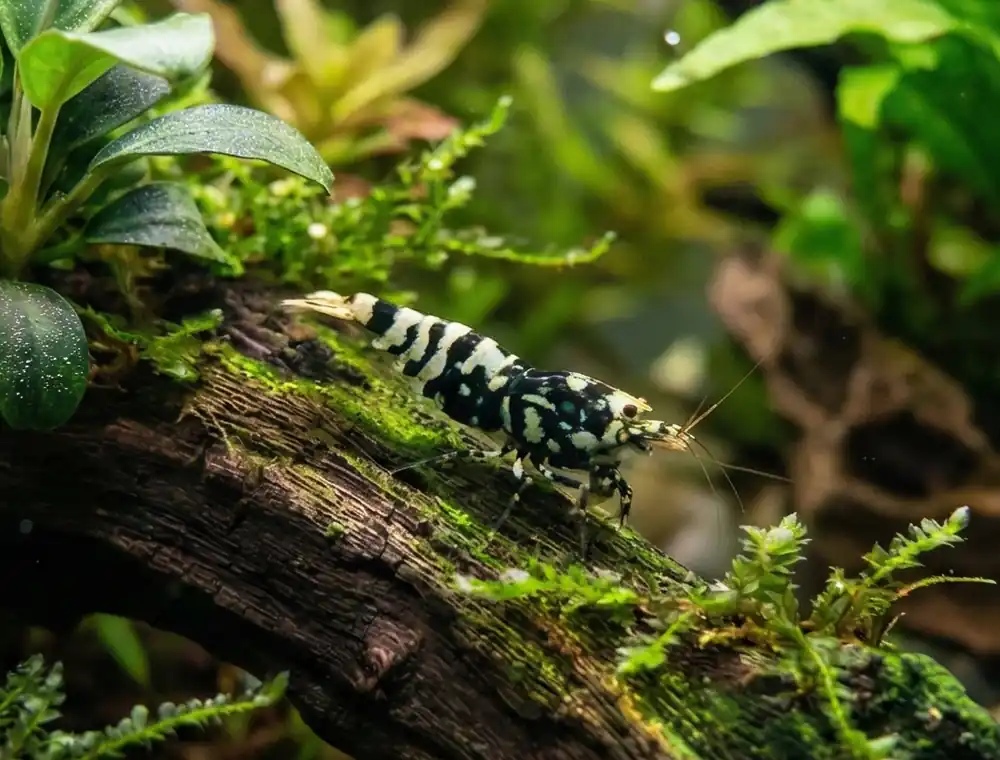
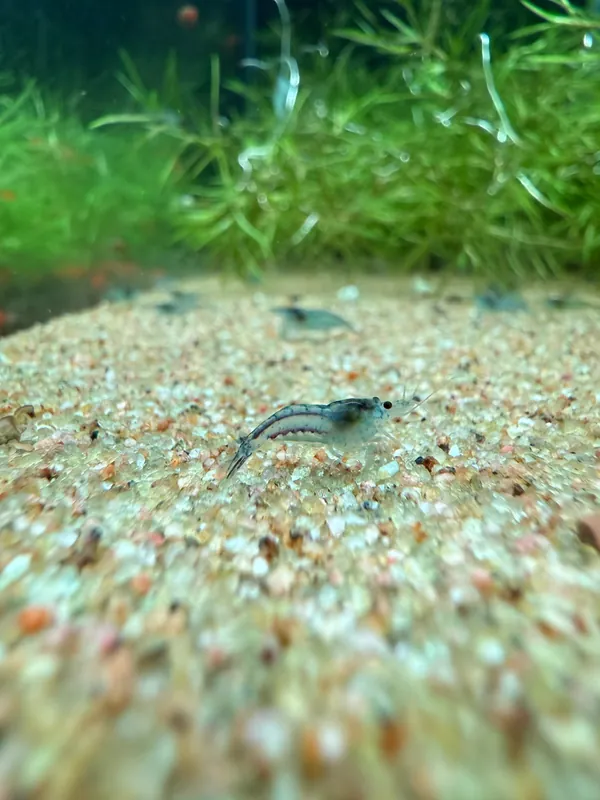
Black Galaxy Fishbone Caridina Shrimp
Black Galaxy Fishbone Caridina Shrimp(Caridina cf. cantonensis) displays the Fishbone pattern in black — the spine-like dorsal marking and lateral branches in white against a deep black body, with galaxy iridescent speckles. The black and white fishbone pattern is particularly graphic and well-defined against the dark base.
⚠ Copper Warning:Copper isfatalto all shrimp — even trace amounts. Never use copper-based medications or treatments in any aquarium housing shrimp.
TheCaridina cf. cantonensiscomplex — which includes Crystal Red and Black, Taiwan Bee, Pinto, Fishbone, Mosura, Shadow Panda, and many other varieties — originates from the mountain streams of southern China. Crystal Red Shrimp were first discovered as a spontaneous red mutation in a Japanese hobbyist’s tank in 1996 by Hisayasu Suzuki — a single moment that launched one of the most extensive selective breeding programs in freshwater invertebrate history. From that original mutation, decades of dedicated breeding produced the extraordinary range of patterns and color forms available today. Tiger shrimp (Caridina mariae) come from streams of Hong Kong and southern China and represent a related but genetically distinct line.
A note on interbreeding:Caridina varieties within the same species group will interbreed freely. Crossing established lines — while sometimes done intentionally by advanced breeders — will degrade the patterns of both varieties in subsequent generations. Keep each variety in its own dedicated aquarium.
Caridina shrimp require soft, acidic water maintained withRO (reverse osmosis) wateras the base — tap water is not suitable as the mineral content is too variable and typically too high. Always start with RO water and remineralize to the correct parameters usingSalty Shrimp GH+, which adds the precise mineral profile Caridina need without raising KH.WIO Artist Florabedactive substrate is strongly recommended — it naturally buffers pH into the correct range and maintains the low KH that Caridina require, making parameter management significantly easier. Once established, Caridina aquariums are remarkably stable — the key is getting the setup right from the start.
Caridina shrimp are active, social, and continuously foraging — grazing every surface of the aquarium for biofilm, algae, and food particles throughout the day. A mature, heavily planted aquarium with established biofilm provides an ideal environment. Dense planting, driftwood, and leaf litter give shrimp hiding places that make them feel secure and dramatically increase the amount of time they spend in the open. Females carrying eggs — calledberried— carry the clutch visibly beneath the tail. Caridina breed more slowly than Neocaridina but a healthy colony in stable parameters will grow steadily.
⚠ Water Changes:Caridina shrimp are sensitive to parameter fluctuation — large or frequent water changes are one of the most common causes of stress and failed molts. Keep water changes to10% maximumat a time, and only when necessary. Always use RO water remineralized withSalty Shrimp GH+to exactly match your tank parameters before adding, and match temperature precisely. When in doubt, do less rather than more — a stable tank with slightly elevated parameters is safer than a tank subjected to frequent changes.⚠ Acclimation — Go Slowly:Caridina shrimp must be acclimated very slowly to a new aquarium — sudden parameter changes are a leading cause of losses on arrival. The preferred method isdrip acclimation: attach an airline tube with a knot or valve to create a slow drip from the tank into the bag or container, running for at least 60–90 minutes until the water volume has at least doubled. If drip acclimation equipment is not available, addone tablespoon of tank water to the bag every 5 minutesfor at least 45–60 minutes before releasing the shrimp. Never rush this process.Feeding & Care Tip:GlasGarten Shrimp Dinner 2is our recommended daily staple.GlasGarten Bacter AEis equally essential — the biofilm it builds is the primary food source for juvenile shrimp and one of the most important ongoing supplements for any Caridina tank. Sprinkle lightly on the water surface 2–3 times per week.
For treats, rotateGlasGarten Shrimp Snacks(Snow Flakes, Dandelion, Mulberry, Leaves Mix),GlasGarten Shrimp Lollies 4 in 1, andGlasGarten Protein XPfor additional protein support during breeding and molting periods.
GlasGarten Mineral Junkie BitesandGlasGarten Mineral Foodare critical for successful molting — Caridina are more sensitive to mineral deficiencies than Neocaridina. Add these regularly.
For newborn shrimplets,GlasGarten Shrimp Baby FoodandBacter AEbiofilm are the primary food sources in the first weeks of life.
Caridina shrimp are best kept in a species-only or invertebrate-only aquarium. Any fish — even small peaceful species — will stress shrimp and reduce breeding. If fish must be included, choose only the smallest and most peaceful options such as Ember Tetras or Otocinclus, ensure the tank is heavily planted, and accept that shrimplet survival will be reduced. Shrimp-only setups produce the healthiest colonies and the most rewarding observation.
Molting is the most critical and vulnerable period for Caridina shrimp. For 12–24 hours after molting the new shell is soft and the shrimp is defenseless. Never remove molted shells — shrimp consume them to reclaim minerals. Afailed molt— where the shrimp cannot fully exit the old shell — is almost always caused by mineral deficiency or a parameter fluctuation. Stable parameters, regular mineral supplementation, and conservative water change practices are the best prevention.
| Black Galaxy Fishbone Caridina Shrimp | |
|---|---|
| Difficulty | Intermediate — rewarding for prepared keepers |
| Temperament | Peaceful — species-only or invertebrate-only recommended |
| Adult Size | 1.0–1.5 inches (2.5–4 cm) |
| Group Size | 10 minimum — colonies of 20+ thrive |
| Recommended Stocking | 5–10 per gallon in species-only setups |
| Ideal Temperature | 68–74°F (20–23°C) |
| Ideal pH | 6.0–6.8 |
| Ideal GH | 4–6 dGH |
| Ideal KH | 0–2 dKH |
| Ideal TDS | 100–150 |
| Staple Food | GlasGarten Shrimp Dinner 2; GlasGarten Bacter AE |
| Treat / Supplement | GlasGarten Shrimp Snacks; GlasGarten Shrimp Lollies 4 in 1; GlasGarten Protein XP; GlasGarten Mineral Junkie Bites; GlasGarten Mineral Food; GlasGarten Shrimp Baby Food (for juveniles) |
| Origin | Mountain streams of southern China — selectively bred in captivity |
| Notes | Substrate:WIO Artist Florabed — buffers pH and maintains low KH Water Base:RO water only — remineralize with Salty Shrimp GH+ Water Changes:10% maximum; match parameters and temperature precisely Acclimation:Drip acclimate or tablespoon method — minimum 60 minutes Copper:Fatal — never use copper medications in shrimp tanks Molting:Do not remove molted shells; mineral supplements essential Interbreeding:Keep varieties separate — crosses degrade established patterns Tankmates:Species-only recommended for best results |
Reviews
There are no reviews yet.